NeuroFly doesn't animate a fly. It runs one. 6,406 neurons and 708,130 synapses, taken from the measured wiring of an actual fruit fly brain, solved a thousand times a second. Lunge at her with your cursor and the same neuron that fires in a real fly fires here — four milliseconds later she is gone.
Her terrarium sits on the right, her brain on the left — every spike, every firing synapse, live. Nothing she does was scripted.
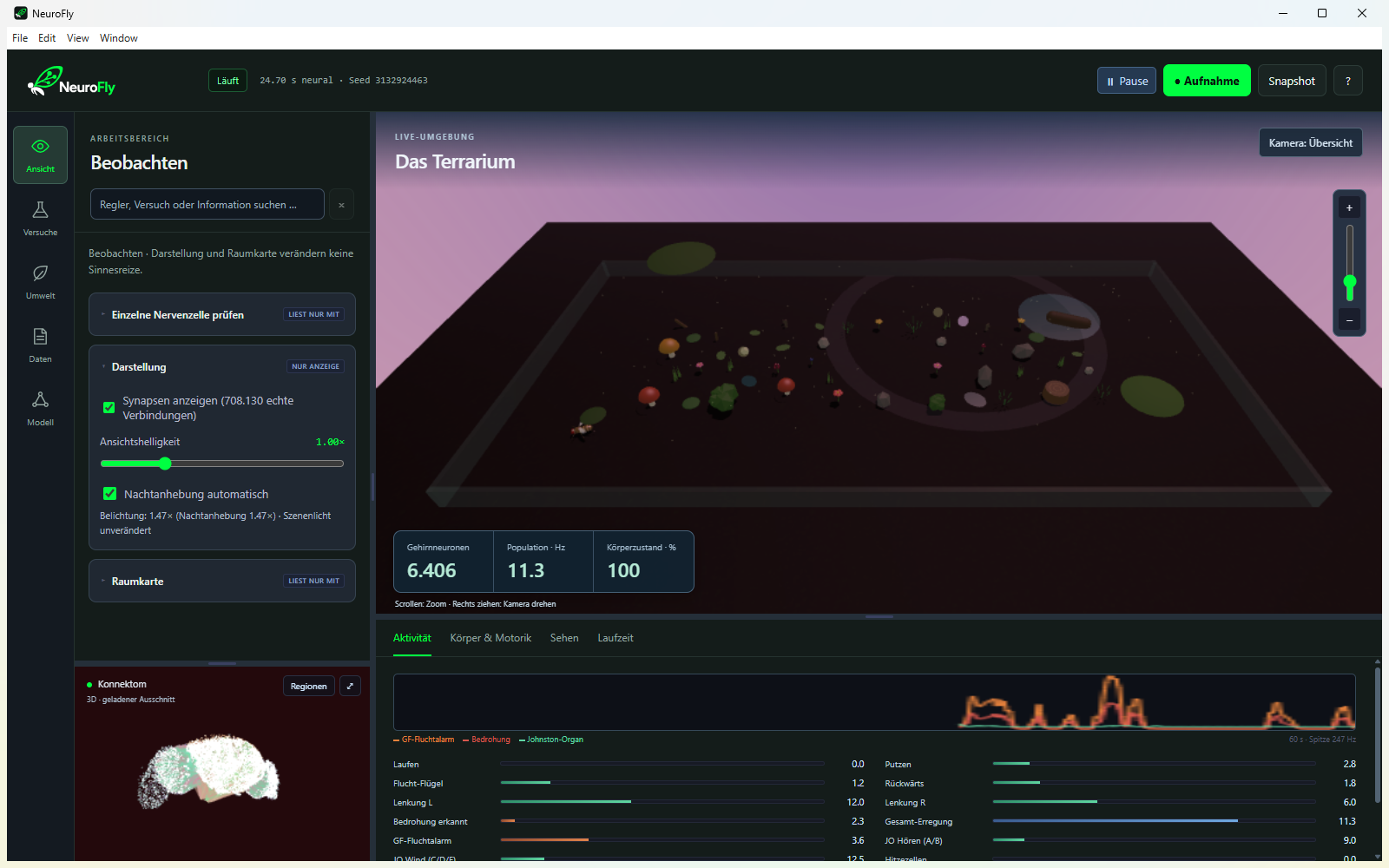
Every connection comes from FlyWire, the completely mapped wiring diagram of a fly brain. Which cell excites which, and how strongly, is measured — not numbers tuned until the demo looked good.
Wind reaches only the wind neurons of her antenna, sound only the hearing cells, heat and cold only her real thermoreceptors. What follows is decided by the wiring, not by a rule someone wrote.
Walking commands go to a second real network taken from a fly's ventral nerve cord. Joints and ground contact are computed, and the result is reported back to her brain — a closed loop, a hundred and twenty times a second.
Change the weather, the temperature, the time of day. A spatial map records where she spends her time, and every run exports as a CSV you can analyse yourself.
All of these run through her nervous system. None of them is a canned animation.
This project is only worth anything if its claims hold. So here is what it cannot do.
Nobody can read off a simulation whether anything inside it is felt. NeuroFly shows model activity and behaviour — not consciousness, not pain, not emotion. There is deliberately no "sentience meter".
For context the app reports its scope against the eight criteria of Birch et al. (2021) and shows openly which of them appear in the model at all. Most do not: this slice of the brain contains no nociceptors, for instance, so it cannot represent pain even in principle.
Wiring and synapse counts are measured. Cell dynamics, sensory transduction, body mechanics and behaviour are models. That line runs through the whole program and its documentation.
The extract is her escape and steering core, not a whole brain.
Brain and nerve cord come from different specimens, joined by a documented modelled interface — not by real nerve fibres.
VALIDATION.md logs corrections, including a measurement that overturned an earlier claim this project itself had made.
Free, no account, no advertising. Windows 10 and 11.
Unzip and run. Nothing is installed, nothing is written to your system.
Coming shortlyEvery wiring dataset is public and checkable. The app stores a SHA-256 fingerprint of each input file with every run, so two recordings can never be silently mixed.
| Source | What it contributes | Licence |
|---|---|---|
| FlyWire FAFB v783 | Brain: 6,338 neurons and 703,381 signed synapse edges, plus real cell types and the thermoreceptors | CC BY-NC 4.0 |
| MaleCNS v1.0 | Nerve cord: 1,045 neurons for walking, with muscle channels and sensory feedback | CC BY 4.0 |
Because the FlyWire data carries a non-commercial licence, NeuroFly is free and stays free: no ads, no sale, no paid features.
It is a real, measured piece of one. The connections between these 6,406 neurons were traced in an actual fly brain and are used exactly as measured. What is modelled is how each cell behaves electrically — a standard integrate-and-fire model, not a molecular reconstruction of a neuron.
There is no way to tell that from a simulation, and this program does not claim it. It shows activity and behaviour. That is also why it has no happiness bar, no pain meter and no consciousness score.
The brain data is published under a non-commercial licence. Selling the program would break that licence, so NeuroFly is free — and it carries no advertising or tracking either.
Windows 10 or 11 and a few hundred megabytes of disk space. The simulation runs on the CPU, the terrarium on the GPU; a laptop from the last few years is plenty. The app measures its own throughput and lowers render quality before it ever lowers simulation accuracy.
The code is MIT-licensed — use it, modify it, ship it. The neural data keeps its own licences: FlyWire CC BY-NC 4.0 (non-commercial, attribution) and MaleCNS CC BY 4.0 (attribution).